Voices From the Past

-Sally Blanchard-O’Brien, Archives Month Committee Member

Through correspondence, voices of the past come alive for us in the present. Here, we take a look at two nineteenth century letters that not only bring the details of the writers’ life into focus, but that shed light on the moments and movements of history of which they were a part.

In 1815, Jonas Clark wrote home after traveling to Montpelier, where the legislative session was beginning in October of that year. Clark was serving his fourth term as Representative for Middletown, and wrote in his letter that he was “very much fatigued” after the long journey. He then went on to write about election results. 1815 was an interesting point in Vermont election history, as Jonas Galusha won the governor’s race against the incumbent Martin Chittenden.  Galusha had held that office before, prior to Chittenden. The two campaigned against each other for five years, and the two years previous to 1815, neither candidate had won a majority. This meant that Vermont legislators, including Jonas Clark, chose the state’s Governor. But, in 1815, Clark’s letter tells that Galusha won by a majority, the first time in three years that a gubernatorial candidate won outright.

Letter from Representative Jonas Clark to wife, October 15th, 1815. Courtesy Vermont State Archives and Records Administration, record series A-365.

Jonas Clark served in public office in many capacities, and even ran for governor himself many years later. Knowing that he later ran an unsuccessful campaign, it’s interesting to read his report home about the 1815 gubernatorial election. Even while participating in the legislative session, Clark tried to manage domestic affairs back in Middletown; he writes his wife Betsey “whenever a leisure time happens…the cellar should be cleaned, it can be done in wet weather.”

Another letter written to a wife back home comes from Sergeant Valentine Barney, a Civil War soldier from Swanton. He served in the First Regiment of the Vermont Volunteer Infantry, which was officially mustered into the United States Army in May of 1861, stationed at Fort Monroe in Virginia. On May 19th, the Vermonters saw their first actual fighting with the attack on the steamer “Monticello,” and Barney writes of it to his wife Maria. He tells her “the report is that some 18 or 20 of the Enemy were killed but how true it is is not known by me, but we could see the firing and hear the report plainly.”

The first page of a multi-page letter from Civil War soldier Valentine Barney to his wife, May 19th, 1861. Courtesy of Vermont State Archives & Records Administration, record series PRA-356.

Barney wrote his wife often, and through his letters we can observe the experience of a Union soldier away from home and his family. In his letter, he writes first about his concern for his family’s health before even mentioning the fighting. He also tells Maria, “I never before realized so forcibly the comforts of a home and the kindness and goodness of my loving wife and children as at the present, and I hope and trust that I may be more attentive to them in the future than I have been in the past.” Barney’s regiment returned home after a three month campaign. However, less than two years later, Barney was commissioned as a Lieutenant Colonel for the Ninth Regiment, serving until several months after the end of the Civil War.

The Jonas Clark letter is housed at the Vermont State Archives and Records Administration. The Valentine Barney letters were microfilmed by the Vermont Civil War Centennial Committee, and later digitized through the University of Vermont. You can read the May 19th, 1861 letter in its entirety, and many others, online.
The Voices of a Place: The Brattleboro Words Project

-Mary Ide, Archives Month Committee Member

On October 23rd, the Brattleboro Museum and Art Center is scheduled to host the public presentation the work of the Brattleboro Words Project.  Over the past three years, the members and volunteers of the Words Project  have worked with local archives, libraries and community resources to produce self-guided audio tours and a book that tell the story of writing in the Brattleboro community, from the distant past to the present.

From Abenakis using writing to defend their homeland, and Lucy Terry Prince, regarded as the first African-American poet, to Nobel Prize winners and contemporary authors, Brattleboro and its environs have a rich and varied literary history.  The Words Project captures and documents this long and fascinating chronicle of the people, places and events that tell the story of writing, publishing and printing in the region.

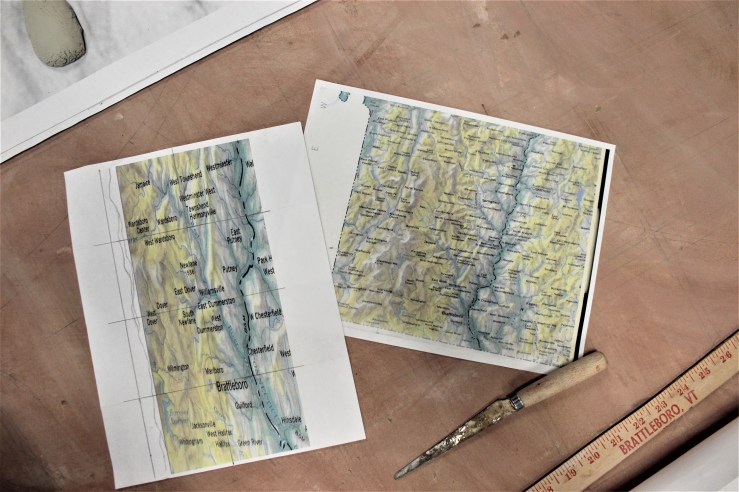
Maps of Brattleboro area on drafting board.
Brattleboro area maps used in an artistic carving for the Brattleboro Words Project, created by Brattleboro graphic artist Cynthia Parker.

The Words Project has been made possible through a grant from the National Endowment for the Humanities and lots of local support.  The Words Project is a collaborative effort of five local organizations: the Brattleboro Literary Festival, Brattleboro Historical Society, Brooks Memorial Library, Write Action and Marlboro College.

The goal of this project is to help connect all of us and our visitors to the stories behind the rich history of the places we share.

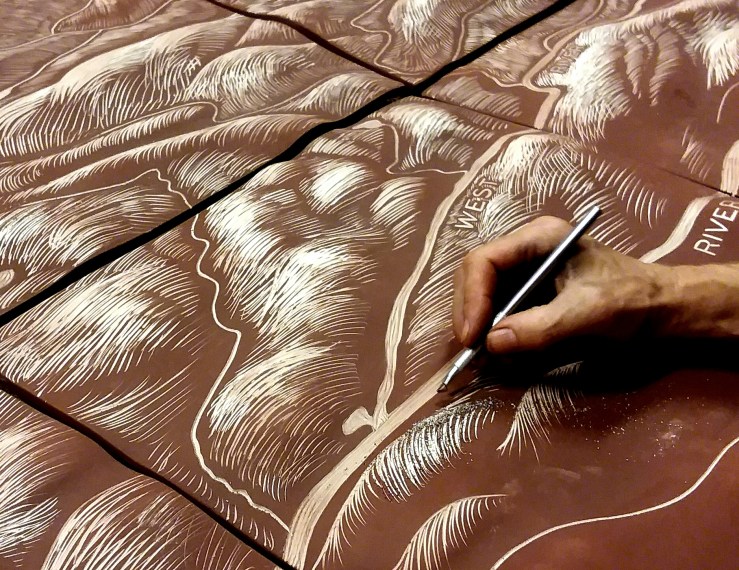
Hand carving a landscape.
Artistic engraved map, created by Brattleboro graphic artist Cynthia Parker, will show people and places of importance, such as writers, printers, and publishers.

For more extensive information about the Words Project, go to http://brattleborowords.org/

What Is An Archives?

-Sally Blanchard-O’Brien, Archives Month Committee Member

Welcome to the inaugural post of the Vermont Archives Month Blog! We will be using this space over the coming months to explore archives and this year’s theme of Vermont Voice and Vote. We wanted to start by looking a little bit at the history of Archives Month and the importance of archival records.

American Archives Month began as one week in October, 1989. It was started by the Archivists Roundtable of Metropolitan New York to raise awareness about the importance of archives. It didn’t take long for the idea to catch on around the state of New York and the rest of the United States, ultimately expanding to a full month of recognition. By 2006, Archives Month was officially promoted by the Society of American Archivists (SAA), the largest American professional organization for archivists, and has now become the cornerstone for the promotion and celebration of archives. For more information about American Archives Month, you can visit SAA’s website.

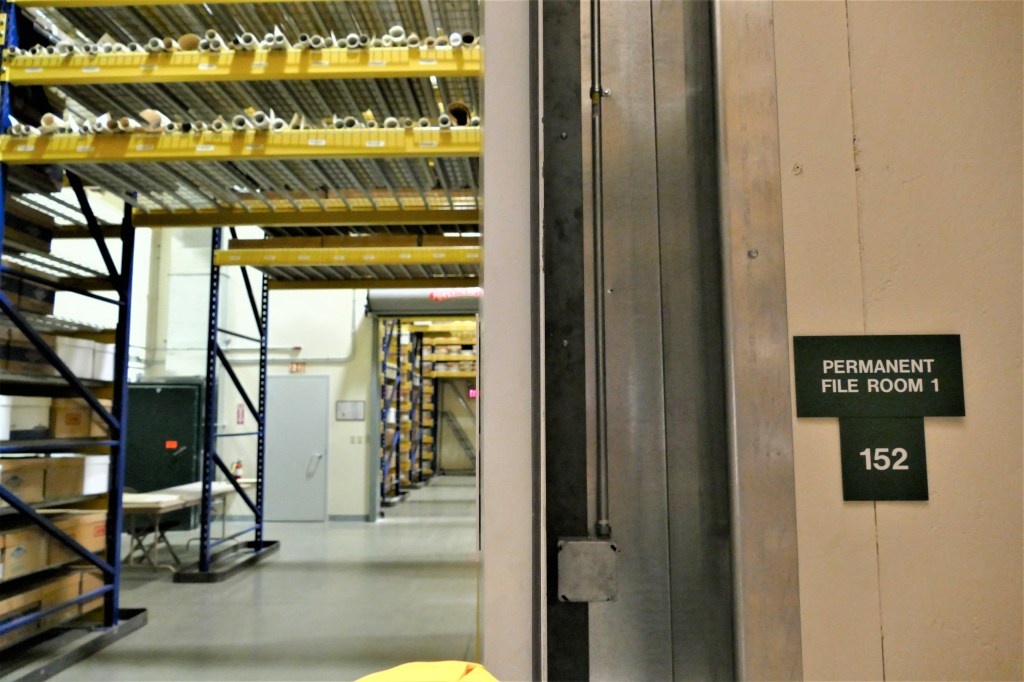
Inside archival record storage at the Vermont State Archives & Records Administration, Middlesex.

But what is an archives? How are they different from libraries and what’s so important about archival records anyway?

Libraries and archives are both places that collect and compile informational resources. But while libraries have published materials like books and journals that can be found in many places, archives may contain documents that don’t exist anywhere else. Libraries contain secondary sources – information on a topic compiled from many different sources. Archives, on the other hand, are made up of primary sources. These are the records that were made at the time an historical event happened or in the course of daily life – the map drawn up by the original settlers of a town, the case file that made up a lawsuit, the first-hand diary of a 19th century farmer. Because these records are unique and serve as evidence of the past, they must be carefully preserved so they can endure for the future – as these records have, in addition to providing rich resources for historical research, a direct impact on our lives.

Archival records come in many different analog and digital formats.

Archival records are not some dusty things sitting in a vault waiting to be discovered. Records can protect lives by providing proof of identity or citizenship. Records protect property through land deeds, wills, divorce decrees, showing who owns what. Records protect legal rights through court decisions, adoption proceedings, and military service. Records restore order after a disaster the documentation of administrative decisions. And records preserve our history so that we can learn for our future. You can read more about the importance of records on the Council of State Archivists’ website.

Keep watching this space for more posts celebrating archives and related to this year’s theme of Vermont Voice & Vote!

Note: Why is it “an archives”?

American and Canadian archivists tend to use the term “archive” as a verb to mean the act of transferring records to a repository, and the term “archives” to mean that repository – a singular gathering place of collections of records. And because “archives” is referring to one singular place, it’s treated as a singular thing (“an”/“is” rather than “some”/“are”).