Hardwick Gazette Picture Project

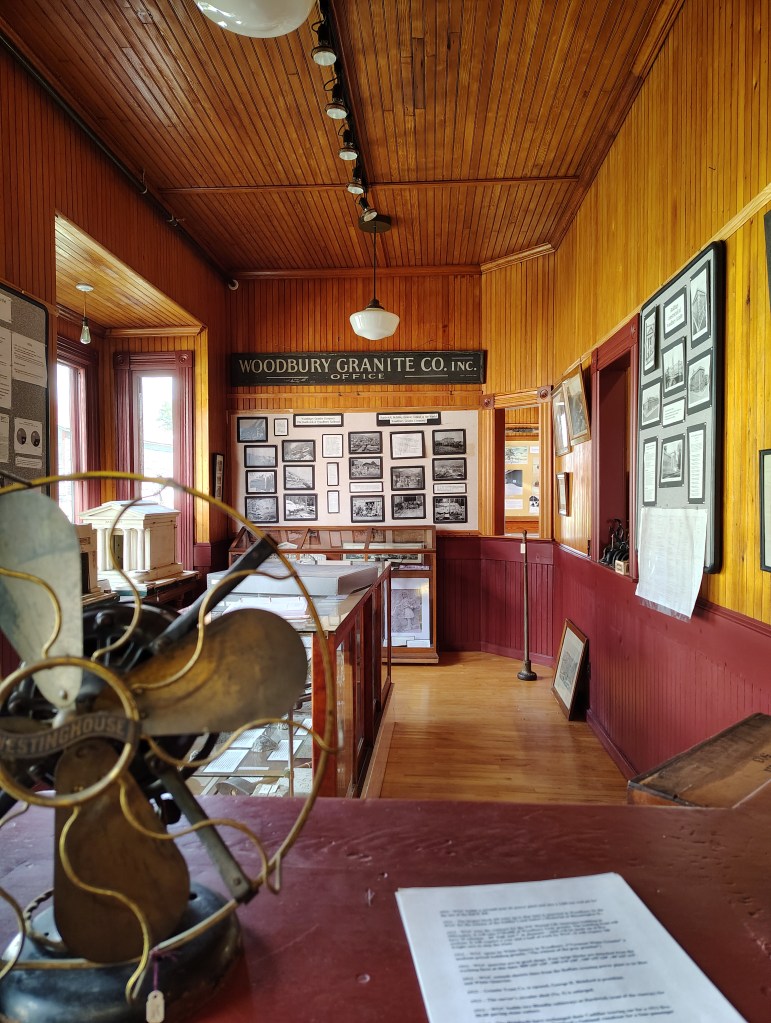
Hardwick Historical Society resides in the old Hardwick Train Depot along the Lamoille Rail Trail

~Elizabeth Dow, Hardwick Historical Society

A few years ago, the new owners of the Hardwick Gazette, our local newspaper, offered the Hardwick Historical Society the collection of 40 years of photographs, negatives, and contact sheets left in the office by the previous two owners. We immediately said yes, and it was a couple years before we did the math. Probably just as well. For 40 years, the paper had published 51 issues. Each issue contained at least 20 pictures–some many more. We could reasonably estimate that we had more than 41,000 images to process. Fortunately, the newspaper staff had filed each month’s pictures in a manilla envelop with the negatives and contact sheets.

            Step 1: Identify the pictures and write the metadata on the back including: Hardwick Gazette, publication date, page, people, place, and/or event as described in the caption or story that accompanied the photo in the newspaper.  For each pack of pictures we pulled the published newspaper, and turned pages, matching pictures, and writing the metadata on the back. We quickly made some decisions. For instance: no baby pictures from the “I’m One” column that ran for years; no glossy publicity shots for theatrical acts. Neither contains a lot of local historical information.

            We identified pictures related to other towns, and then we put them in a container that we eventually sent to that town’s historical society. While we put the names of graduates or team members on the back of Hardwick pictures, we did not do that for the classes or teams from other towns. It simply took too much time.

            This part of the project included as many as a half dozen volunteers working around a large table together, and it created a trip down memory lane that just never ended. A good time was had by all, until our hands began to cramp.

            Step 2: File the pictures. Each picture went into a folder with others like it, and the folder  went into a lateral file drawer. We developed a facetted index to organize the files. We could categorize a picture of a couple kids on a playground 1) by the kids’ names, 2) by the game they were playing, 3) by the playground 4) by the season of the year, etc. So we chose to file pictures by reason the photographer took the picture. If the photographer wanted to highlight the new playground equipment at the school, we filed the picture under “Schools–Hardwick Elementary–Playground, 1990-1999.” If the photographer meant to feature kids enjoying themselves during a summer activity, we filed the picture under that activity, e.g. “Recreation—Hardwick Summer Recreation Programs” or “Schools—Hazen Union—Sports—Basketball—Summer Program.”

            We had some hitches. At first each newly engaged or married couple got its own folder. Then we saw how much drawer space that would take, and redid the folders by years and listed the couples in the index with the date of their engagement or wedding. And it took a while to sort out the difference between a sport and a recreation. Answer: “Sport” usually involves organized competition — e.g. basketball; “Recreation” usually does not — e.g. bicycling.

            The project took a total of about six years to complete, but it has provided us an invaluable resource. Take a look: https://hardwickvthistory.org/wp-content/uploads/2025/09/Pictures20250919.pdf
Archives Discovered

~By Brian Lindner of Waterbury, VT

Can a 1969 Cold Case be solved by materials found in an archive?  Can a mysterious fatal fire from 1935, with diametrically opposed witness testimonies, finally be solved through old photographs found in an archive?  Can today’s archival collections solve a lingering piece of a 1929 mysterious death?  The answer in each case is “yes” or at least “maybe.”  Amazing answers to old questions can often be solved when materials held in various public archives are studied by members of the general public. 

Cold Case

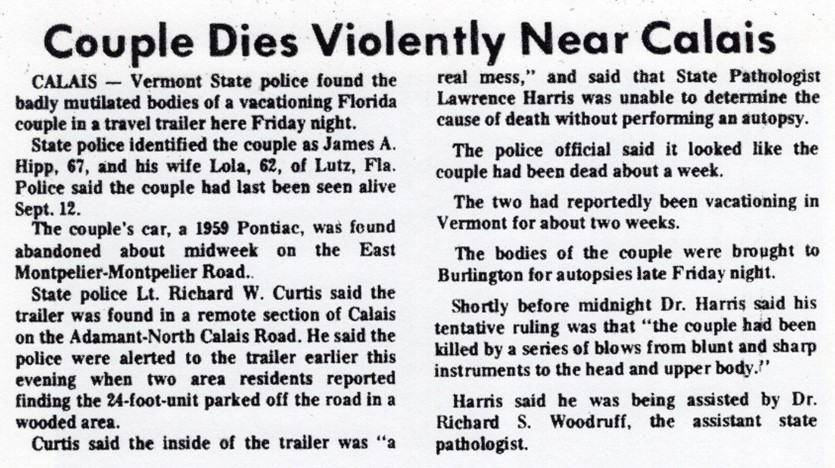
Newspaper article titled, "Couple Dies Violently Near Calais." 
Calais - Vermont State Police found the badly mutilated bodies of a vacationing Florida couple in a travel trailer here Friday night.  
State Police identified the couple as James A. Hip, 67, and his wife, Iola, 62, of Lutz, FLA. Police said the couple had last been seen alive Sept. 12.
The couple's car, a 1959 Pontiac, was found abandoned about midweek on the East Montpelier-Montpelier Road.
State Police Lt. Richard W. Curtis said the trailer was found in a remote section of Calais on the Adamant-North Calais Road.  He said the police were alerted to the trailer earlier this evening when two area residents reported finding the 24-foot-unit parked off the road in a wooded area. 
Curtis said the inside of the trailer was "a real mess," and said that the State Pathologist Lawrence Harris was unable to determine the cause of death without performing an autopsy.
The police official said it looked like the couple had been dead about a week.
The two had reportedly been vacationing in Vermont about two weeks. 
The bodies of the couple were brought to Burlington for autopsies late Friday night.
Shortly before midnight Dr. Harris said his tentative ruling was that "the couple had been killed by a series of blows from blunt and sharp instruments to the head and upper body."
Harris said he was being assisted by Dr. Richard S. Woodruff, the assistant state pathologist.
Burlington Free Press

In 1969, James and Iola Hipp of Florida were murdered while vacationing in central Vermont and their case has never been solved.  However, in the nearly six decades since that crime, a scrapbook of newspaper clippings maintained by an alleged loner was donated to the Vermont Historical Society after he passed away in 1987.  At the very time of the killings, the scrapbook owner had begun saving newspaper clippings of homicides in central Vermont (there were several) that year.  At the scene where the Hipp bodies were found, a slaughtered fawn was discovered.  In his scrapbook, along with the stories of the homicides, the owner was also chillingly saving newspaper clippings of dead deer.  He stopped collecting clippings when the cluster of homicides suddenly ceased.  Coincidence?

Image of newspaper with pictures of deer walking across a landscape, and an up-close image of a deer standing.  In the background, the title reads, "Pet Deer Slain."
The Times Argus

Civilian Conservation Corps Disaster

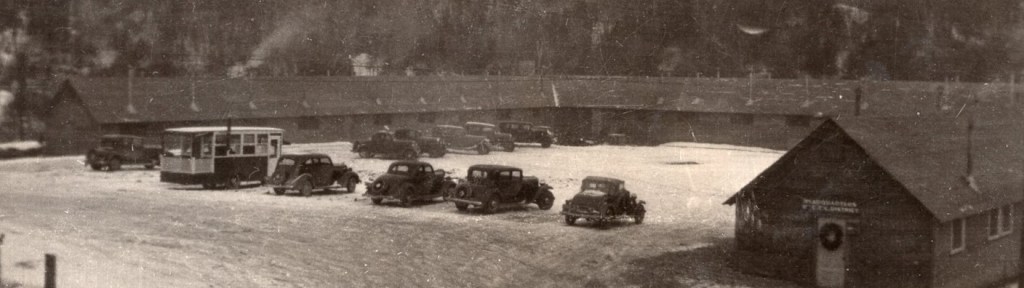
Black and white image of the Officer's Quarter at Camp Charles Smith in Waterbury.  It is a single-story u-shaped building with cars parked in the center and along the open edge.
Photograph taken days (maybe hours) before the fire.  Waterbury Historical Society

On Christmas Night 1935 at 2:30 AM the Officer’s Quarters at Civilian Conservation Corps (CCC) Camp Charles Smith in Waterbury erupted in flames.  Four Army officers perished in the roaring inferno that left the motel-sized building level to the ground in less than 15 minutes.  The entire Board of Inquiry file is available from the U.S. National Archives in College Park, MD.  A read of the file shows several witnesses claimed to see the fire start but none agreed on where; the point of origin was never determined.  The board concluded there was no evidence of arson, but they were unable to officially determine how and why the deadly fire started.

Unofficially, CCC veterans, the newspapers, and locals suspected methane gas could have been both the cause and the reason the building burned so quickly.  The Army was using poorly built and leaky stoves burning cheap soft coal…a recipe for generating methane gas.

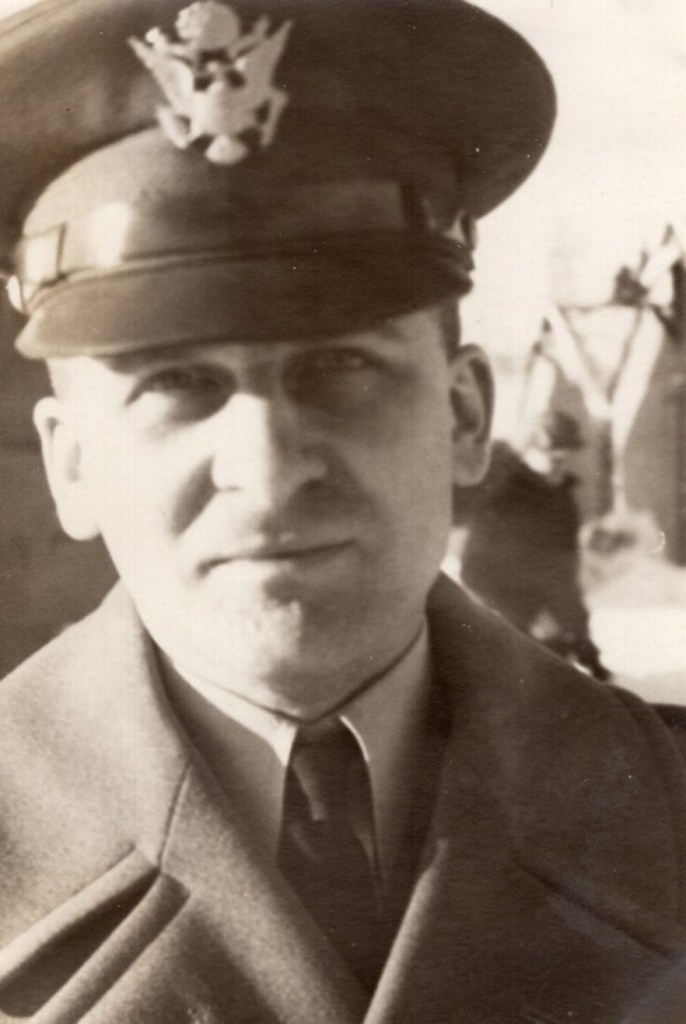
Black and white, three-quarters image of a man in military uniform looking at the viewer.  His coat has a thick collar, and his hat has an eagle emblem.
Lt. Henry Howard.  Waterbury Historical Society

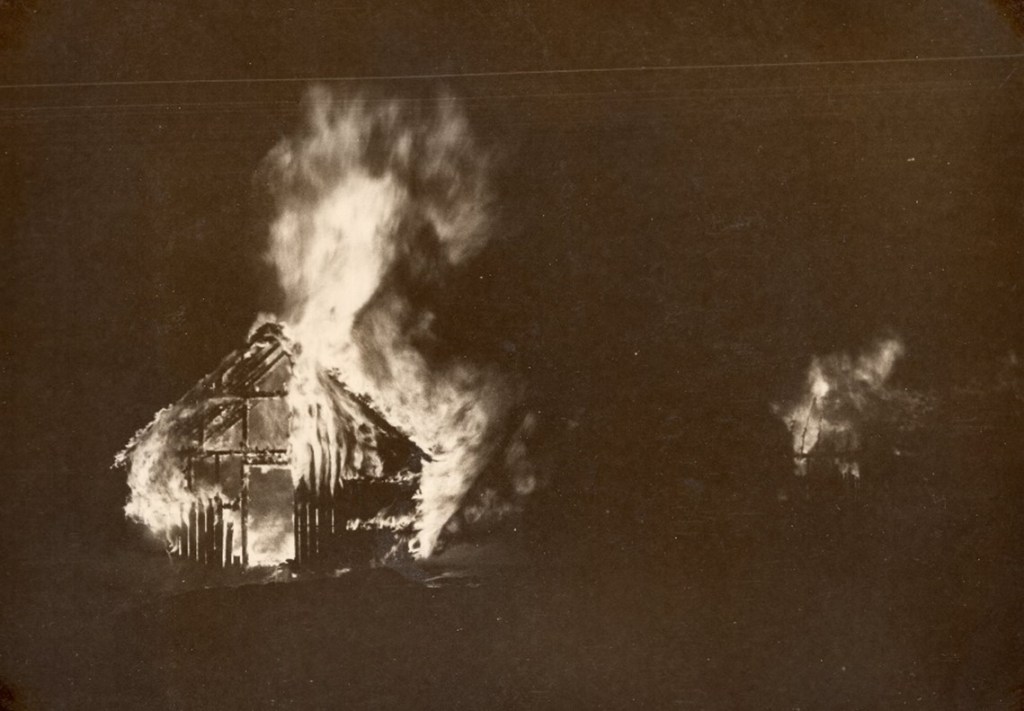
In 1996 the family of CCC Lt. Henry Howard donated his scrapbook of letters, clippings, and photographs to the Waterbury Historical Society for their archives.  Lt. Howard barely survived the fire, and his scrapbook contained the only known photograph of the Officer’s Quarters from before the fire.  AND…there were two astonishing photos that had clearly never been seen by the Board of Inquiry.  These two photos showed the early stages of the fire thereby solving the decades old mystery.  The fire clearly began at opposite ends of the building at the same time: methane gas.  Case closed.  We’ll never know why Lt. Henry hadn’t shared such critical photos with the board despite the fact he was one of the key witnesses at the Inquiry.

Black and white image of a building on fire.  On the left side, the building is lit up by fire shooting out of the top and sides.  The wood framing is exposed, and the siding is almost completely burnt.  In the background on the right, another fire is seen at the other end of the building.
Fire erupts at both ends of the barracks but not in the middle.  Waterbury Historical Society
Color image of a building on fire.  On the left side, the building is lit up by fire shooting out of the top and sides.  The wood framing is exposed, and the siding is almost completely burnt.  In the background on the right, another fire is seen at the other end of the building.
Modern colorized version courtesy of Moriah Keat

Body Never Identified

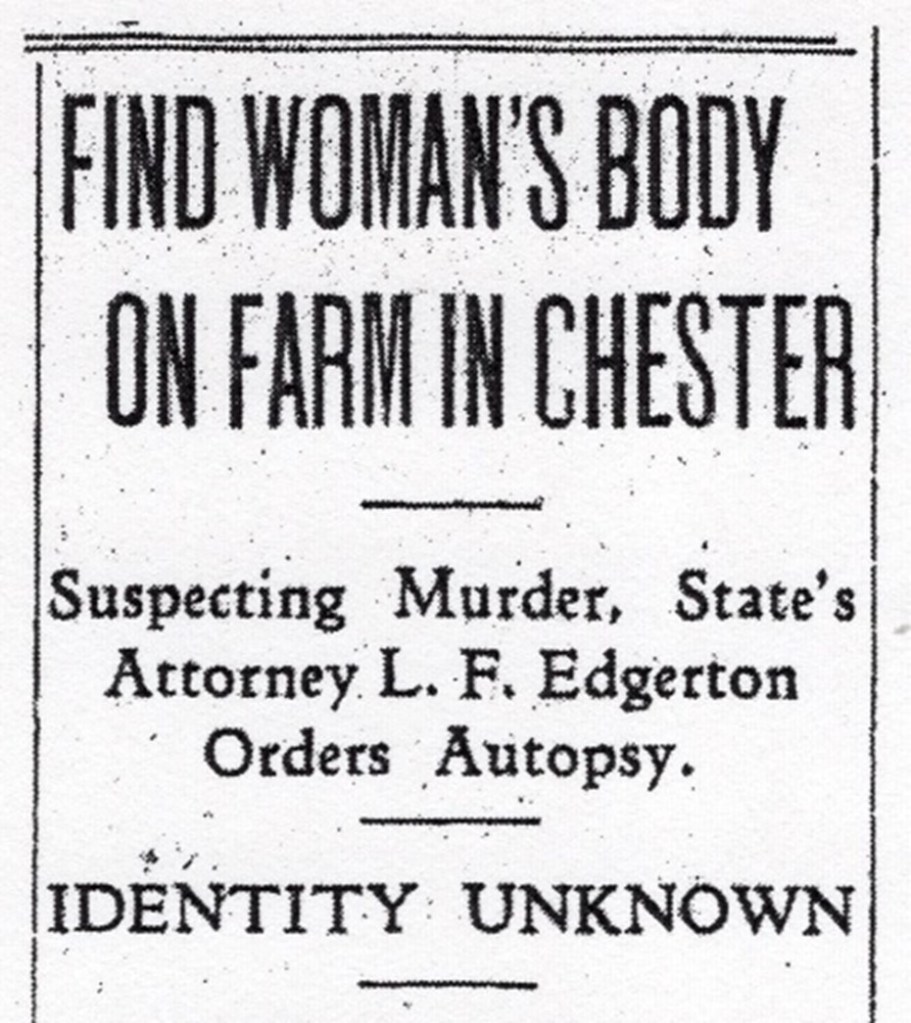
Newspaper article title only, "Find Woman's Body on Farm in Chicester - Suspecting Murder, State's Attorney L.F. Edgerton Orders Autopsy. IDENTITY UNKNOWN"
Rutland Daily Herald

In August of 1929 an unidentified female body was found in a farm field in Chester.  Her identity remains unknown to this day.  Although officially ruled as a suicide, there were very serious doubts within the small group of investigators. 

Among several other females, the body was once suspected of being that of Matilda Anderson, a native of Sweden, who had been anonymously reported as missing from Boston.  There was extensive news coverage about the attempts to find Anderson and the trail seemed to lead to Vermont.  Using today’s newspaper archives at the Vermont State Archives and Records Administration in Middlesex, coupled with the ability to use hindsight, we can easily see Anderson was never missing and she wasn’t from Boston.  She was a resident of Burlington and appeared frequently in the social section of the Burlington Free Press from 1929 all the way to her obituary in 1935.

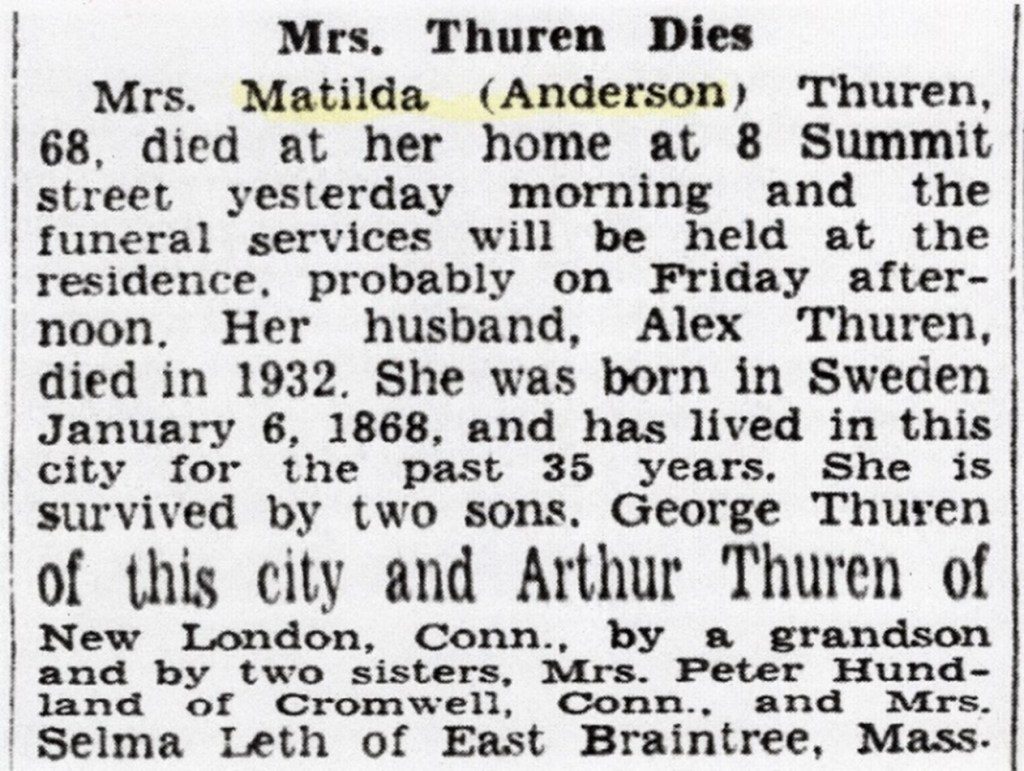
Newspaper Article titled, "Mrs. Thuren Dies"
Mrs. Matilda (Anderson) Thuren, 68, died at her home at 8 Summit Street yesterday morning and the funeral services will be held at the residence, probably on Friday afternoon.  Her husband, Alex Thuren, died in 1932.  She was born in Sweden January 6, 1868, and has lived in this city for the past 35 years.  She is survived by two sons.  George Thuren of this city and Arthur Thuren of New London, Conn., by a grandson and by two sisters, Mrs. Peter Hundland of Cromwell, Conn., and Mrs. Selma Leth of East Braintree, Mass.
Burlington Free Press

If you have an interest in researching an old crime, old disappearance, old tragedy, births, marriages, your street name, or any of an endless list of topics – visit any public archive.  You will be welcomed, and you may find the answer that eluded everyone before you.